启动集群设备

先决条件
-
身份验证-提交您的用户凭据,客户端ID和客户端机密以进行OAuth2身份验证。有关如何调用OAuth API以验证和验证凭据的说明,请参阅API身份验证。
-
呼叫"获取设备类型"以了解要在NE平台上启动的群集设备(例如路由器或防火墙)。您将了解虚拟设备可用的城域地区,设备供应商,可用内核数量以及软件包及其版本。选择
deviceTypeCode,metroCode,core,packageCode和version。 -
调用"获取允许的接口"以找出所选Core允许的接口数量。您可以选择任何可用的设备接口作为sshInterfaceId。 否则,Equinix 将选择第一个可用的接口。
-
拨打"获取帐户{metro}",检查您的
account number(或acountReferenceId)和您需要虚拟设备的metro中的状态。出于计费原因,您必须在Metro中拥有一个帐户,您需要虚拟设备处于活动或待定状态。如果您没有帐户,请创建帐户。如果您是尝试为客户创建设备的经销商,则必须确保客户和您(经销商)的帐户均处于"活动"或"待定"状态。您的帐户将会收到账单,但是,您必须将客户的帐号发送至POST API,以便为您的客户创建设备。
许可选项
截至目前,我们仅为集群提供 BYOL(自带许可)选项。
-
瞻博网络群集-无需上载瞻博网络群集的许可证文件。但是,您可以上传两个许可证文件。要上传两个许可证文件,请两次调用Post License File (许可证后文件)。您将在响应中获得许可证文件IDS,您可以使用该文件创建群集。
-
Palo Alto Cluster -您必须从供应商上传两个许可证令牌。许可证令牌可以相同或不同。
-
Fortinet Cluster -您不需要输入令牌或许可证。如果要上载许可证文件,则必须上载两个不同的许可证文件。要上传两个许可证文件,请两次调用Post License File (许可证后文件)。您将在响应中获得许可证文件IDS,您可以使用该文件创建群集。
-
Arista VeloCloud SD WAN边缘群集您不需要上传许可证文件或令牌。但是,您必须提供激活密钥。如果您的许可证在创建设备后未能注册,您必须登录设备并上传许可证。然后,调用状态值更新虚拟设备
PROVISIONED。
创建集群设备
| POST /ne/v1/devices | |
|---|---|
| 方法 | POST |
| URL 或端点 | /ne/v1/devices |
| 标题 | Authorization令牌,Content-Type |
| 查询参数 | draft,draftUuid |
注意:创建虚拟设备即表示您接受订单条款。致电获取订单条款以查看详细信息。
要保存设备草稿,您必须提供deviceTypeCode,accountNumber或accountReferenceId
和metroCode。
创建 vSRX 集群的示例 curl 请求:
curl -X
POST "https://api.equinix.com/ne/v1/devices?draft=false"
-H "content-type: application/json"
-H "Authorization: Bearer <token>"
-d '
{
    "deviceTypeCode": "VSRX",
    "clusterDetails": {
        "clusterName": "sroy-juniper",
        "clusterNodeDetails": {
            "node0": {
                "vendorConfig": {
                    "hostname": "sr012"
                },
                "licenseFileId": "1274fe9f-511c-436f-bc0c-14c876ec55da"
            },
            "node1": {
                "vendorConfig": {
                    "hostname": "sr123"
                },
                "licenseFileId": "65a9be3f-57fb-4c4d-a15b-40950951bc13"
            }
        }
    },
    "metroCode": "SV",
    "termLength": "1",
    "licenseMode": "BYOL",
    "packageCode": "STD",
    "virtualDeviceName": "Test-device-001-SROY",
    "notifications": [
        "test@equinix.com"
    ],
    "hostname": "sr012",
    "aclDetails": [
       {
         "uuid": "fb2e69bb-cbd7-40c4-bc01-8bcc5fa741c2",
         "interfaceType": "WAN"
       }
    ],
    "accountNumber": "201148",
    "version": "18.4R3-S2",
    "interfaceCount": 8,
    "agreeOrderTerms": true,
    "deviceManagementType": "SELF-CONFIGURED",
    "core": 5,
    "userPublicKey": {
        "username": "sroy",
        "keyName": "keyLlhzL"
    },
    "additionalBandwidth": "100"
}
'
以下是一个用于创建 Arista Velocloud SDWAN 集群的 curl 请求示例:
curl -X
POST "https://api.equinix.com/ne/v1/devices?draft=false"
-H "content-type: application/json"
-H "Authorization: Bearer <token>"
-d '
{
    "metroCode": "SY",
    "deviceTypeCode": "VELOCLOUD-SDWAN",
    "termLength": "1",
    "clusterDetails": {
        "clusterName": "sroy-velo-cluster",
        "vendorConfig": {
            "node0": {
                "activationKey": "GJUK-JM2X-59BJ-SAMPLE",
                "controllerFqdn": "demo.velocloud.net",
                "rootPassword": "TestPassword!"
            },
            "node1": {
                "rootPassword": "TestPassword#"
            }
        }
    },
    "licenseMode": "BYOL",
    "packageCode": "VeloCloud-4",
    "virtualDeviceName": "velo-cluster",
    "notifications": [
        "test@equinix.com"
    ],
    "aclDetails": [
       {
         "uuid": "fb2e69bb-cbd7-40c4-bc01-8bcc5fa741c2",
         "interfaceType": "WAN"
       }
    ],
    "accountNumber": "2393479",
    "version": "3.4.2",
    "interfaceCount": 8,
    "deviceManagementType": "SELF-CONFIGURED",
    "agreeOrderTerms": true,
    "core": 4,
    "userPublicKey": {
        "username": "sroy",
        "keyName": "key7YFfL"
    },
    "additionalBandwidth": "200"
}
'
创建无互联网访问的 PANW 集群的示例 curl 请求:
curl -X
POST "https://api.equinix.com/ne/v1/devices?draft=false"
-H "content-type: application/json"
-H "Authorization: Bearer <token>"
-d '
{
    "deviceTypeCode": "PA-VM",
    "clusterDetails": {
        "clusterName": "NEAut-",
        "clusterNodeDetails": {
            "node0": {
            "vendorConfig": {
                "hostname": "PANCluster"
            }
            },
            "node1": {
            "vendorConfig": {
                "hostname": "PANCluster"
            }
            }
        }
    },
    "metroCode": "#(supportedMetro)",
    "zoneCode": "Zone1",
    "termLength": "1",
    "licenseMode": "BYOL",
    "packageCode": "VM100",
    "virtualDeviceName": "NEAut-",
    "notifications": [
        "t@t.com"
    ],
    "version": "10.1.3",
    "interfaceCount": 10,
    "deviceManagementType": "SELF-CONFIGURED",
    "core": 2,
    "connectivity": "PRIVATE"
}
'
有关参数和选项的完整列表,请参见API参考。
示例响应
示例响应202:已接受请求。
{
    "uuid": "34b7838c-ec82-4166-ac19-efa03b4e34fe",
    "deviceIds": {
        "node0": "34b7838c-ec82-4166-ac19-efa03b4e34fe",
        "node1": "f27f1475-3c7f-447f-b0db-e3bb3af3de16"
    },
    "clusterId": "27eea9aa-327b-431b-bf62-3cee4d880f2e"
}
设备状态
创建群集时,自配置的群集将在
Equinix基础结构中通过各种状态进行转换。可以使用获取虚拟设备{uuid}方法的响应属性监视这些状态status。必须配置群集并注册许可证,然后才能使用此群集连接到云服务提供商。
| 虚拟设备状态 | 说明 |
|---|---|
INITIALIZING | Equinix目前正在预留资源和创建设备。 |
PENDING_ACCOUNT | 客户的帐户未获批准。帐户获得批准后,设备创建将继续。 |
PROVISIONING | 设备正在启动。 |
PENDING_ORDER | 此状态仅适用于从Siebel到NE的订单。客户需要登录Network Edge门户并提交待定订单。 |
PENDING_SIGNATURE | 客户尚未接受Network Edge条款。 |
CANCEL_ORDER | Siebel 发给 NE 的订购已取消。此状态仅适用于从Siebel发送至Network Edge的订单。 |
WAITING_FOR_PRIMARY | 辅助设备已就绪,但主设备未就绪。如果您已请求冗余设备,则可能会出现此状态。 |
WAITING_FOR_SECONDARY | 主设备已就绪,但辅助设备未就绪。如果您已请求冗余设备,则可能会出现此状态。 |
FAILED | 设备创建失败。 |
PROVISIONED | 设备已准备就绪。 |
DEPROVISIONING | Equinix接受了客户删除虚拟设备的请求。 |
DEPROVISIONED | 该设备已取消配置/删除。 |
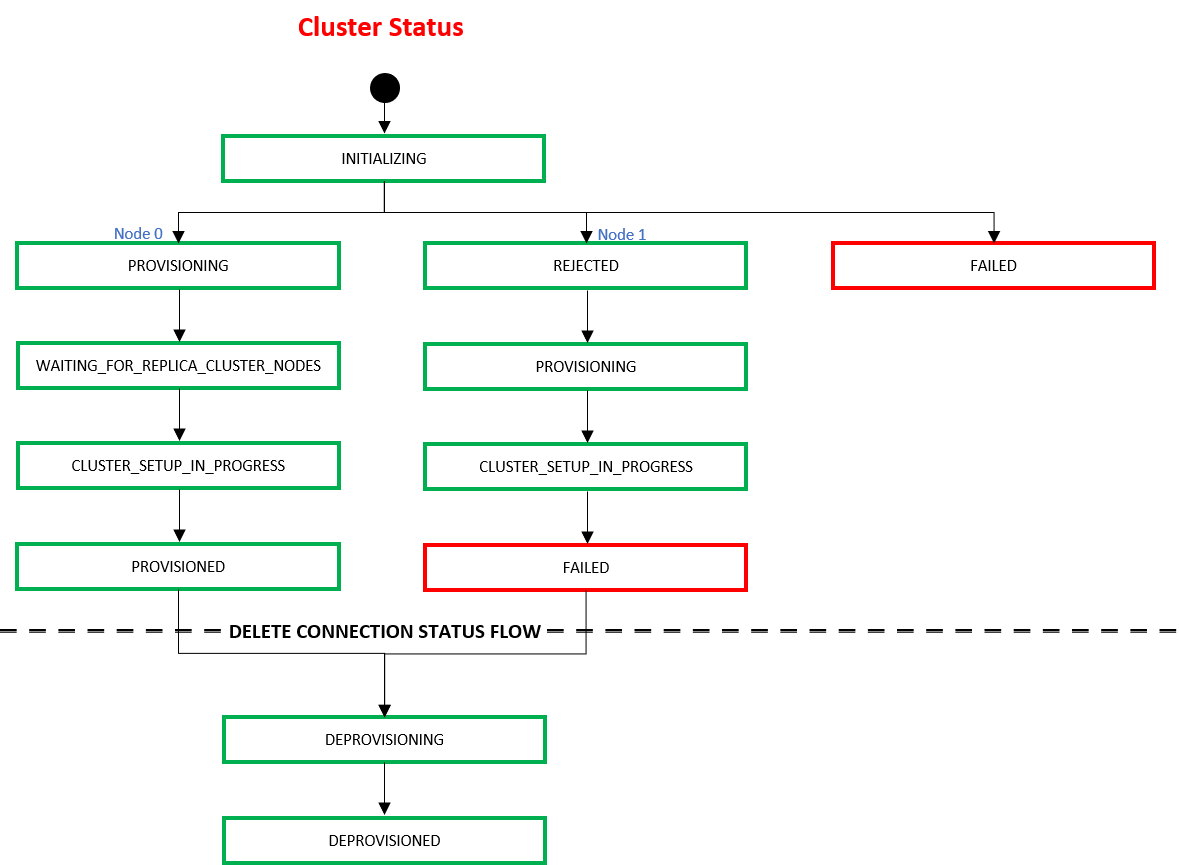
当最终用户使用Delete Virtual Devices API删除设备时,设备会在Equinix 基础结构中通过以下状态转换。
| 地位 | 描述 |
|---|---|
DEPROVISIONING | Equinix接受了客户删除虚拟设备的请求。 |
DEPROVISIONED | 该设备已取消配置/删除。 |