Technical Concepts
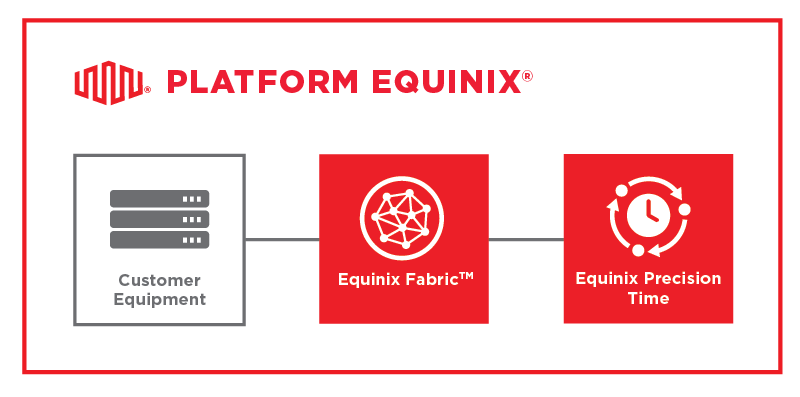
Equinix Precision Time receives accurate time from GNSS sources, then uses industry-standard time protocols to distribute that time across the network.
The Precision Time Time Source
Precision Time sources precise time from the Global Navigation Satellite System (GNSS), including the Global Positioning System (GPS), using GNSS receivers.
GNSS Time Sources and Redundancy
Precision Time infrastructure uses redundant GNSS receivers capable of receiving GPS signal accurately to deliver precise time. In addition, the GNSS receivers are equipped with Rubidium atomic clocks to provide holdover timing accuracy if for any reason connectivity to the GPS signal is lost.
The GNSS receiver and antennas used in the Precision Time infrastructure can receive signals from multiple GNSS constellations, including GPS L1, GLONASS L1, BeiDou B1, Galileo E1, and QZSS L1. Together, these time sources provide multiple levels of redundancy.
Precision Time Server 1 and Time Server 2 each receive time from a separate GPS clock: one sourced from the New York City (NY) timing chain and the other from the Silicon Valley (SV) timing chain, ensuring redundancy across independent timing sources.
Grandmaster Clocks and Holdover Accuracy
The GNSS-enabled grandmaster clocks use Rubidium oscillators that provide accuracy up to the sub-microsecond when locked with the GNSS (GPS) source. Even with a loss of connectivity to the source, the service can maintain up to sub-microsecond level of accuracy.
If a GNSS receiver providing precise time to the Precision Time infrastructure loses connectivity to the satellite constellations, the service relies on built-in redundancy mechanisms. When all GNSS signal sources, including GPS and other constellations, are unavailable, the Rubidium oscillator within each grandmaster clock provides holdover timing. This allows the service to maintain timing accuracy within 1.5 microseconds over a 24-hour period.
Time Servers and Service Locations
Within a given Precision Time service location (for example, Silicon Valley or New York), two redundant GNSS reference time sources provide time to all time server instances. All timing servers in the same service location use the same underlying time source, ensuring consistent and synchronized time delivery.
When two service connections are provisioned to the same Precision Time service location, the underlying GNSS reference time sources are shared across both connections. However, each EPT service connection is backed by its own isolated timing server instance. Although the GNSS reference is common, EPT Time Server 1 on one service connection is not the same instance as EPT Time Server 1 on the other. The timing servers do not share traffic or processing and operate independently of one another.
Time servers are physical servers equipped with high-performance NIC cards, where a pair of namespaces is created from two different servers. One server operates as Time Server 1, and the other server operates as Time Server 2.
GNSS Interference Protection
GNSS services are susceptible to interference from jamming, which occurs when a signal is broadcast on the same frequency as GNSS signals, therefore drowning them out, and spoofing, when a “fake” signal is broadcast directly to a target antenna, causing it to converge on an incorrect solution.
Precision Time protects its GNSS timing signals using integrated GNSS firewall technology within its GNSS servers. This capability is provided through the integration of Orolia BroadShield software with the GNSS receivers. GNSS signals are continuously monitored for signs of jamming or spoofing. When interference is detected, the GNSS link to the antenna is disabled, and time continues to be served using the Rubidium oscillator integrated within the GNSS servers.
The Orolia BroadShield software integration is not available in Hong Kong service locations.
Precision Time infrastructure is hosted in secure IBX data centers within controlled cages and is not exposed to public networks. The service is delivered over the private Equinix Fabric network using RFC 1918 addressing, ensuring that all timing traffic remains isolated from the public internet. Access to the infrastructure is strictly controlled and limited to authorized personnel.
Precision Time Grandmaster Implementation
The grandmaster that is visible to customers in the Precision Time service is a custom hardware-timestamped implementation developed by Equinix to support secure multi-tenancy. Each Precision Time service has a unique process that serves it, with full isolation, over an Equinix Fabric virtual connection. This enables you to adjust settings like the IP addresses, domains, and priority values to match your local environment. All the network and protocol configuration in the service is customized to your connection, and no protocol elements are shared with others.
The only shared component among different customer connections is the stable timebase for hardware timestamps. And at each Precision Time service site, Equinix operates multiple GNSS servers that are protected by anti-jamming and anti-spoofing measures, linked together with White Rabbit hardware. These servers create the stable timebase that all our Precision Time Grandmaster instances use.
Supported Time Protocols
Precision Time supports two time protocols to synchronize clocks on a network:
- Network Time Protocol (NTP)
- Precision Time Protocol (PTP)
While the time accuracy of PTP is better than that of NTP, NTP has the ability to synchronize more devices on the network with low network overhead.
A network can be configured to use either protocol. In both cases, time is sourced from the Precision Time service and distributed to connected devices for synchronization.
PTP and NTP use the User Datagram Protocol (UDP) for time synchronization:
- PTP uses UDP port 319 for event messages and port 320 for general messages.
- NTP uses UDP port 123 for client-server communication.
Accuracy and Synchronization
Accuracy is defined as the maximum deviation between the time delivered by the service and Coordinated Universal Time (UTC). For PTP packages, the origin and destination must be in the same metro. For NTP packages, accuracy for remote connections may vary slightly.
Precision Time is continuously monitored using a global service level agreement (SLA) monitoring platform to ensure consistent performance.
Typical synchronization accuracy observed in production environments:
- NTP: 30-100 microseconds or less (99.9th percentile), depending on network performance.
- PTP: 1-10 microseconds or less (99.9th percentile), depending on network performance.
NTP Service Level Agreements
Precision Time does not provide an accuracy SLA for NTP. In same-metro production deployments, typical observed accuracy is 30-100 microseconds or less at the 99.9th percentile. For remote connections or more variable network paths, observed accuracy may instead fall within the 1-10 millisecond range, depending on network conditions and deployment.
| SLA | Requirements to Meet SLA | Comments |
|---|---|---|
| 99.9% | Use at least one Fabric port or virtual device. | Connect to any available service location as described in Service Locations. |
| 99.999% | Use two Fabric ports or virtual devices on primary and secondary networks, with separate Precision Time connections. | For each service connection, connect to any available service location as described in Service Locations. Connecting to two different service locations will help achieve an additional level of geo-redundancy. |
PTP Service Level Agreements
The Precision Time PTP service provides an accuracy SLA of 50 microseconds or less, depending on network architecture and deployment conditions. Typically, the accuracy is up to 5-10 microseconds.
| SLA | Requirements to Meet SLA | Comments |
|---|---|---|
| 99.9% | Use at least one Fabric port. | Connect to a service location in the same metro as the Fabric port, as described in Service Locations. |
| 99.999% | Use two separate Fabric ports created on primary and secondary Fabric networks. Create two separate Precision Time service connections using each Fabric port. | For each service connection, connect to a service location in the same metro as its Fabric port, as described in Service Locations. Using Fabric ports in different metros provides additional geo-redundancy. |
Leap Second Handling
Precision Time receives leap second updates from the Internet Assigned Numbers Authority (IANA) and applies these updates using timing‑specialized equipment to maintain alignment with Coordinated Universal Time (UTC).
Network Time Protocol (NTP)
Precision Time supports these NTP standards:
- NTPv3 (RFC 1305)
- NTPv4 (RFC 5905)
NTP is a lightweight, standard networking protocol used for clock synchronization. It is intended to synchronize participating computers in a network to within a few milliseconds of UTC. NTP servers synchronize devices in a network using GNSS or other time servers that trace back to a true time source via peer networking.
Precision Time NTP servers operate at stratum level 1, meaning they are directly synchronized with highly accurate reference clocks.
NTP is typically described as a client-server system, but it can as easily be used in peer-to-peer relationships, where each peer can act as a potential time source. While NTP is easy to configure, it can be less secure than PTP when used over the public internet.
Precision Time NTP uses leap second correction, with leap seconds applied directly by the timing infrastructure to maintain alignment with Coordinated Universal Time (UTC). Leap smearing and slewing are not used.
Precision Time NTP is delivered over a private, secure connection using Equinix Fabric with VRF isolation, so additional authentication mechanisms are not required. MD5 authentication is supported for NTP Enterprise configurations, while other mechanisms such as NTS are not supported.
Precision Time currently supports IPv4 connectivity only. IPv6 is not supported.
Precision Time Protocol (PTP)
Precision Time supports the 1588-2008 IEEE standard, titled "Precision Clock Synchronization Protocol for Networked Measurement and Control," and commonly referred to as Precision Time Protocol v2, or PTP.
A PTP server (also known as a grandmaster clock) synchronizes time across a network with sub-microsecond accuracy. To achieve time accuracy, PTP requires all devices being synchronized to have a network interface controller (NIC) that supports hardware timestamping. This requirement extends to intermediate network infrastructure such as routers and switches.
PTP is commonly used in systems that require highly-accurate time, such as measurement and control systems. The protocol is currently used to synchronize financial transactions, mobile phone tower transmissions, and sub-sea acoustic arrays.
Hardware timestamping synchronizes the PTP hardware clock directly with the time source. Packets are timestamped at the network interface, before entering the kernel or user space, which eliminates processing delays and improves accuracy.
Software timestamping synchronizes the system clock and is typically used by NTP. Because timestamps are generated in software, this approach is more susceptible to processing delays and provides lower accuracy compared to hardware timestamping.
Precision Time supports multicast PTP configurations with end-to-end time distribution from the grandmaster clock to client devices. Redundant time servers enable automatic failover and fallback.
Precision Time uses the default Time to Live (TTL) value for multicast PTP packets, which is 64. This value is not explicitly configurable within the service and is controlled by the underlying PTP implementation.
Domain values in PTP are used to isolate timing domains and do not indicate the source or traceability of time.
Precision Time was initially launched with a default domain value of 30 to differentiate the service from customer environments that typically use domain 0. This default does not indicate the use of an internal oscillator or a lack of traceability.
Precision Time remains fully traceable to Coordinated Universal Time (UTC) through redundant GNSS time sources and distributed timing infrastructure across service locations.
The PTP domain number and related parameters, including priority and packet rate, can be configured in the Customer portal. New connections now default to domain 0.
Precision Time provides default PTP server settings that can be used to configure client-side priority and clock selection:
- Priority1: 128
- Priority2: 128
- clockClass: 13
Precision Time is compliant with SMPTE 2110-10, which is based on the IEEE 1588 Precision Time Protocol (PTP) standard.
Main Service Components
The diagram below shows the main service components of a Precision Time system deployed on a global scale. The diagram details the New York metro, and shows a device in Toronto connected to the Precision Time service.
Definitions
- GPS Antenna – A GPS antenna is a device that receives the distinct radio-frequency signals sent by GPS satellites. The antennas convert the GPS signals into electronic signals that they then broadcast to GPS receivers.
- GPS Network Time Server – GPS network time servers are computer devices that receive highly-accurate time from the GPS system, and broadcasts that time to the clocks of the devices deployed on the network (including routers, switches and other servers). Typically, time servers support either NTP or PTP for clock synchronization.
- Grandmaster Clock – Grandmaster clocks receive UTC-based time information from an external time reference, most commonly a GNSS satellite source (for example, GPS). This time is then distributed downstream to the clocks of client devices. When successfully receiving a reference signal, the grandmaster derives accurate time from the reference.
- Boundary Clock – A boundary block (BC) is a clock node that has two or more ports. For example, a router or Ethernet switch might be capable of operating as a BC. A BC generally has one port in the role of a secondary clock, and the remaining ports take the role of the master clock.
- Equinix Fabric – Securely, directly, and dynamically connects distributed infrastructure and digital ecosystems using the global Platform Equinix. Use the Customer Portal to establish secure, on demand, data-center-to-data-center network connections by connecting your data centers to Equinix Fabric ports. For details, see the Fabric documentation.