Digital Infrastructure Management (DIM)
Digital Infrastructure Management (DIM) is a proactive operational management service based on Information Technology Service Management (ITSM) best practices. It is intended to maintain the availability, performance, governance, and security of customer infrastructure across both physical and virtual environments.
DIM supports physical and virtual targets within Equinix, including Equinix Digital Services and assets located in IBX data centers, limited to technologies identified in the Technology Matrix.
The Equinix Managed Solutions (EMS) team comprises certified, multidisciplinary professionals equipped with the tools and expertise to manage diverse infrastructure targets while meeting defined service and availability level agreements (SLAs).
In addition to routine maintenance and regular analyses, timely and relevant insights are provided to support strategic decision-making, along with unlimited support for managed items.
Main Features
DIM provides comprehensive infrastructure management through the following capabilities:
-
Availability and Performance Management - Continuous monitoring and proactive recommendations to maintain infrastructure availability and performance in alignment with business objectives.
-
Rapid Response - Round‑the‑clock support to address detected anomalies, resolve incidents, and fulfill customer requests from the service catalog.
-
Growth Planning - Regular capacity management analysis and growth recommendations to help customers scale efficiently and plan for future needs.
-
Governance, Security and Compliance - Visibility into system updates, access controls, and hardening measures to reduce risk and maintain a consistent security posture.
-
Change Management - Support for managing change processes to reduce service disruption and associated risks.
-
Service Level Agreement - Defined SLAs that establish response expectations and availability targets for managed infrastructure components.
Management of Equinix Solutions
Digital Infrastructure Management can be applied to complete managed solutions using an environment‑centric approach rather than focusing on individual components. Equinix Solutions consist of all elements required for specific use cases, including hardware, software, and other Equinix services, deployed in the customer’s cage or cabinet within Equinix facilities and based on validated blueprints approved by Equinix and, in most cases, the relevant technology vendors. This approach provides comprehensive management of defined environments and solutions.
In these scenarios, the Digital Infrastructure Management SLA may cover the entire solution and take precedence over individual component‑level Service Level Agreements, abstracting the other components included in the solution.
Examples of such solutions include, but are not limited to the following:
- Network Edge
- Managed Private AI with NVIDIA DGX
- Dedicated network core environments with dedicated firewalls and switches
- Dedicated private cloud solutions
Scope of Activities
The scope of activities refers to the Digital Infrastructure Management base service and may vary depending on the specific technology being managed.
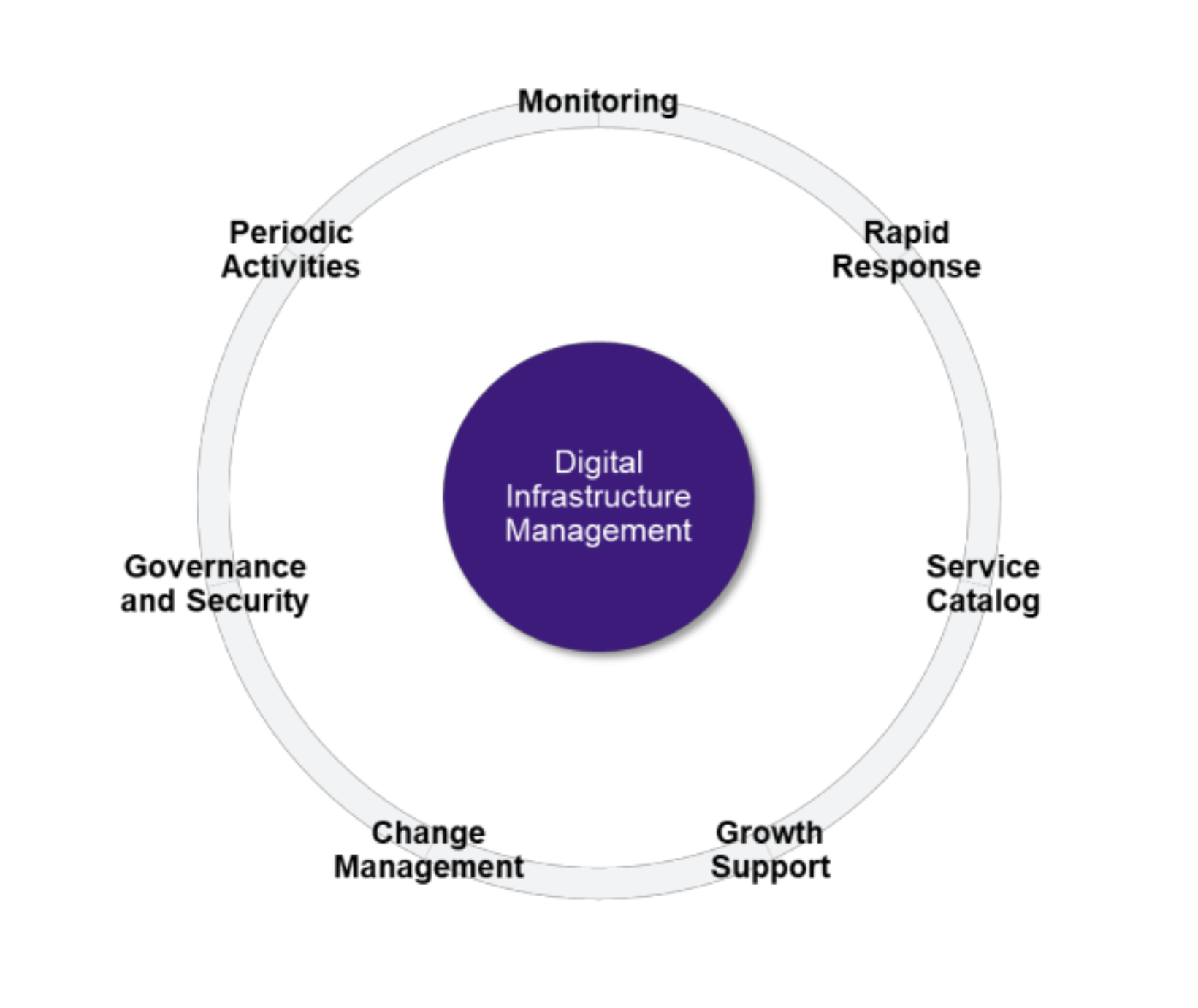
Monitoring
Equinix monitors the infrastructure at the system level using configured alerts based on defined severities, providing visibility into the health of the managed environment. The objective is to maintain a real‑time view of system availability, performance, and potential risks to enable timely response before issues affect operations.
Based on monitoring results, Equinix provides insights, early warnings, and change recommendations to reduce impact and minimize potential service disruptions. This information is also used to maintain expected performance levels through ongoing assessment and configuration optimization. This pillar may include activities that address both current performance and the long‑term improvement of system operations.
Rapid Response
The customer’s infrastructure is managed by Equinix to maintain continuous availability and support efficient operation of essential components. In the event of a service disruption, Equinix performs corrective operational activities to restore services, as planned in coordination with the customer.
This activity is part of incident management and is not subject to support‑hour charges. An incident may be initiated by a customer request or by an Equinix response to an observed situation. Digital Infrastructure Management includes 24x7x365 support.
The following actions are within the scope of incident management:
- Executing required troubleshooting activities
- Interaction with technology vendors or third parties
- Incident investigation and continuous improvement
- Problem Management
- Post‑Incident Review (RCA) for P1 incidents (upon customer request)
Resolution of incidents outside the DIM scope, such as issues caused by customer actions or by contracted third‑party services (e.g., software, applications), will be billed on an hourly basis through Managed Services Premier Support. Incident prioritization is based on the following assessment and may be adjusted as analysis progresses:
| Priority | Impact/Urgency | Description |
|---|---|---|
| P1 HIGH | Unforeseen unavailability of a service or environment managed by Equinix, in accordance with the service description. The customer cannot fulfill obligations to its users. The customer experiences direct demonstrable damage due to the unavailability of this service. | The service must be restored immediately. The production environments are unavailable, with platform-wide disruptions. |
| P2 MEDIUM | The service does not offer full functionality, has partial functionality, or reduced performance, affecting users. The customer experiences direct demonstrable damage due to limited availability of the functionality. | The service must be repaired the same day. |
| P3 LOW | The service functions with limited availability for one or more users, and a workaround is in place. | The repair timeline is determined in consultation with the reporting person. |
Service Requests
Service Requests are used when the customer needs to request an action from the Equinix team. Customers may submit a Service Request for service changes that cannot be completed through Self Service in the Operational Console or when assistance is required in the EMS Portal.
Two types of Service Requests are available:
- Included: Service Requests that fall within the scope of the service and do not incur additional charges.
- Additional: Service Requests that fall outside the scope of the service and result in additional charges.
Guidance is available for Service Requests that can be completed through self‑service. In these cases, procedural instructions are provided, and the customer’s execution of the task is overseen. Additionally, each technology listed in the Equinix Technology Matrix includes its own set of service request options.
| Type of Service Request | Self-service | Type |
|---|---|---|
| Ask information about the product | No | Included |
| Move DIM service from one target to another | No | Included |
| Request Change Management support | No | Included |
| Request Escalation List updates | No | Included |
| Request Identity and access management changes | No | Included |
| Request ad-hoc reporting | No | Additional |
| Request ad-hoc critical patching update | No | Additional |
| Request ad-hoc capacity evaluation | No | Additional |
Growth Support
To maintain availability, it is also necessary to manage environment capacity. The Equinix team monitors key KPIs for the managed technology and informs the customer when changes are required to avoid availability impact.
Change Management
Change management in infrastructure operations ensures that planned changes are carried out in a controlled, organized, and secure manner, minimizing risks and service disruptions. This process provides both the customer and the Equinix management team with visibility into upcoming changes before execution, including advance communication and coordinated planning.
The activities included in change management include:
- Planning and coordination of changes
- Risk and impact assessment
- Authorization and approval of changes
- Change notification and communication
- Execution and monitoring of the change
- Post‑implementation validation and testing
- Change rollback
Types of Changes in Change Management:
- Equinix‑initiated changes: Infrastructure maintenance and update activities, such as security patching and version upgrades of network devices.
- Customer‑requested changes: Changes initiated to meet customer needs, such as software upgrades, configuration adjustments, or adding new features or components to the environment.
Well‑implemented change management supports operational efficiency and service continuity, while improving the security and predictability of infrastructure operations.
Governance and Security
The Governance and Security framework in Digital Infrastructure Management ensures that services and their supporting infrastructure are managed with a structured lifecycle management approach.
This framework follows industry best practices and provides customers with reporting and recommendations to support decisions on the evolution of their environments.
The primary objective is to maintain the integrity and availability of the customer environment while generating compliance evidence and operational assurance.
The main activities include:
- Periodic reporting: Asset management insights, executed SLAs, recent incidents and problems, completed changes, and active risks.
- Critical security patching: Recurring activity to identify security gaps and initiate change management to apply required updates to the customer environment.
- Identity and access management: Mapping and reporting of divergences by the Equinix team.
- Firewall rules evaluation: Review of requested firewall rule changes prior to implementation.
Equinix also provides recommendations to enhance infrastructure architecture based on the customer’s use case to support improvements in security posture and operational resilience.
Periodic Activities
The EMS team performs defined periodic activities, including checking for new critical patching updates and firmware versions, to help maintain the availability, performance, and capacity of managed customer devices. Conducting these activities on a recurring basis provides Equinix with the ability to identify issues early and reduce the likelihood of environment disruptions.
Some activities apply only to specific regions or technologies, and their frequency is managed by Equinix.
Service Description
Service Options
Digital Infrastructure Management provides three service variants that allow customers to select the option that aligns with their requirements. For each management target, the customer may choose the service option that is most appropriate.
Equinix applies these variants to align cost with the complexity of management, which is determined by estimated labor requirements and the tools needed to deliver Digital Infrastructure Management.
Starter
This service option includes a limited scope focused solely on infrastructure monitoring. Additional activities may be performed under the Premier Support Plan, subject to the limitations defined in the Technology Matrix and Service Catalog.
Standard
This service option includes the full service scope defined in this document for virtual or physical networking devices, firewalls with basic features, and dedicated storage.
Advanced
This service option includes the full service scope defined in this document for AI/GPU‑based equipment, firewalls with advanced features, and hyper‑converged appliances.
Service Demarcation & Enabling Services
As part of Digital Infrastructure Management, Equinix defines the boundary of responsibilities between the customer and Equinix, collects information about the management targets specified by the customer, and performs the activities required to prepare for ongoing management.
The procedure may include:
- Initial meetings and activity scheduling
- Establishing connectivity between the customer and Equinix environments
- Validating requirements and access/permissions
- Installing management tools on supported equipment
- Configuring monitoring elements
- Applying standard (best‑practice) settings for supported technologies (hardening)
- Documenting the initial customer environment
- Establishing the escalation matrix between customer and Equinix
- Validating environment SLAs
Transition Phase
After completing these procedures, Equinix begins a transition period of up to ninety (90) days. During this period, the Equinix team manages all targets, but the Digital Infrastructure Management SLA does not yet apply.
The purpose of the transition phase is to align expectations and validate environment characteristics. No SLA credits are issued during this period, and Equinix has no liability for failure to meet the SLA.
Limitations
Digital Infrastructure Management covers only the infrastructure items selected as management targets and listed in the Equinix Technology Matrix. These items may be customer‑owned or Equinix‑owned. SLAs apply only to managed items.
Equinix periodically checks for Critical Patching updates (including minor updates) and carries out change management to apply them. For major releases and other non‑critical updates, Equinix informs the customer when a new version becomes available; execution of these updates may require additional services.
Equinix maintains administrative credentials for managed items solely for operational purposes. However, Equinix does not supervise, monitor, or control the content or data stored or transmitted by the customer and has no legal obligation or technical capability to do so.
Equinix uses proprietary and approved tools aligned with operational and security standards. These tools are included in the service charges. Equinix may recommend additional native tools for specific technologies; adoption is optional and may require customer investment.
If a customer requests the use of a specific tool in their environment, Equinix evaluates its compatibility and determines whether it meets operational and security requirements. This evaluation includes confirming that the tool supports service execution.
Equinix is not liable for customer data content, including its origin, integrity, accuracy, confidentiality, or compliance with intellectual property or contractual obligations. The customer is responsible for all transmissions, including any that may violate legal or ethical requirements.
The customer also retains full responsibility for e‑commerce and e‑business transactions, including handling of confidential information such as credit card numbers, codes, and passwords. Equinix is not liable for issues arising from such transactions.
Equinix has no control or access to the customer’s data content.
Firewall management includes only basic firewall features. Advanced capabilities such as application‑level controls or data loss prevention (DLP) are not included in scope.
Purchase Units
Digital Infrastructure Management is priced based on the number of target items to be managed, according to the Component Type assigned to each item.
| COMPONENT TYPE | UNIT | NRC | MRC | OVERAGE |
|---|---|---|---|---|
| Standard | Each | Yes | Yes | May apply |
| Advanced | Each | Yes | Yes | May apply |
- Non-recurring Installation Fee (NRC) - Covers service implementation and configuration on components used by the customer during service enablement, in alignment with Equinix operational best practices and the level of service defined in the agreement.
- Monthly Recurring Charge (MRC) - Represents ongoing billing for the service based on the number of components included in management, according to their component type as defined in the service scope.
- Overage - Charges applied when managed quantity exceeds the baseline.
Roles & Responsibilities
Customer Responsibilities
The customer must provide, in a timely manner, the information and access required to enable delivery of the service. This may include administrative access to customer‑owned or customer‑managed equipment, as well as ensuring the accuracy of all data and information supplied to Equinix.
Service Requirements
Digital Infrastructure Management applies only to environments hosted in Equinix IBXs and limited to approved technologies—including models and versions—listed in the Equinix Technology Matrix.
To manage an environment, Equinix defines a set of restrictions and prerequisites for each supported technology. These may be mandatory or based on best practices. The level of customer adherence to these prerequisites directly affects the availability SLA agreed and validated during service enablement and the transition period.
Factors that may influence the applicable SLA include:
- Architecture with some level of redundancy or high availability
- Support coverage for components not provided by Equinix
- Existence of a backup solution (via Equinix or a third party)
- General governance of the environment
- Alignment with technology‑specific best practices
Connectivity Requirements
To perform management activities, Equinix requires remote, private, and direct access to the customer environment, following the recommended connectivity framework.
The customer must configure a Fabric connection that provides secure communication between their environment and the DIM service. This Fabric connection is not included in DIM pricing.
A dedicated access path to DIM must be available through Fabric connectivity. This approach improves latency, ensures an exclusive communication channel, and reduces the risk of congestion.
If Equinix loses connectivity to the environment, all reasonable actions will be taken to restore access. During such an outage, an Out‑of‑Band (OOB) network may be used, if available in the customer environment. If the loss of connectivity is caused by customer actions that prevent Equinix access, Equinix will notify the customer and request restoration of access. When no OOB or redundancy is present, or when customer actions prevent access, service‑level objectives (SLOs) and SLAs are suspended until connectivity is restored.
Additional Customer Responsibilities
The customer is also responsible for:
- Providing Equinix with designated business and technical contacts for communication and escalation.
- Supplying appropriate and complete instructions for service activities, including environment details relevant to service catalog tickets.
- Assuming responsibility for all software, services, and components not provided by Equinix, including selection, use, compatibility, monitoring, and troubleshooting.
- Managing permissions in the EMS Portal.
- Submitting tickets with correct classification and urgency, including sufficient information.
- Managing the Primary Admin role for Equinix portals.
- Assuming responsibility for any activity executed through the EMS Portal.
- Managing the content of all data stored in the customer environment.
- Informing Equinix of all continuity policies related to the managed environment.
- Approving changes suggested by Equinix through the EMS Portal.
RACI Matrix
R = Responsible, A = Accountable, C = Consulted, I = Informed
| Activities | Equinix | Customer |
|---|---|---|
| Define escalation list | CI | RA |
| Ensuring Equinix is an authorized partner for 3rd-party infrastructure support | CI | RA |
| Network required to connect to Equinix Management tools | CI | RA |
| Setup infrastructure monitoring | RA | CI |
| Provide Equinix all available and requested documentation about the environment | CI | RA |
Acceptance into Service
| Activities | Equinix | Customer |
|---|---|---|
| Validation of escalation list | RA | CI |
| Inform internal teams on how to report issues or open requests | CI | RA |
| Check if all teams succeed in accessing EMS Portal | CI | RA |
| Provide Equinix team information about the environment and its importance to business | CI | RA |
| Share with Equinix all business Service Levels used to drive work | CI | RA |
| Pre-schedule meeting to present first Periodic Reporting to customer | RA | CI |
Operational
| Activities | Equinix | Customer |
|---|---|---|
| Infrastructure / platform upgrades (Major releases) | CI | RA |
| Management of targets outside DIM scope or Equinix Technology Matrix | CI | RA |
| Opening of issue or request tickets | CI | RA |
| Approve change windows | CI | RA |
| Request root cause analysis | CI | RA |
| End user support | CI | RA |
| Application management | CI | RA |
| Selecting and providing Equinix Management systems / tools | RA | CI |
| Engaging with third-party supplier as necessary | RA | CI |
| Responsible for all Software Licenses in use in the environment | CI | RA |
| Provide Equinix any updates in personnel to allow permission and access management changes | CI | RA |
| Inform updates on escalation lists | RA | CI |
| Problem Management follow-up | RA | CI |
| Request change management support from Equinix | CI | RA |
Service Levels
The purpose of this Service Level Agreement (SLA) is to define the measurable performance levels associated with the DIM service and to describe the remedies available to the customer if Equinix does not meet these levels.
Support SLO
The Support SLO applies to incident registration and resolution activities (see Rapid Response). Equinix aims to respond to and resolve ninety‑five percent (95%) of submitted trouble tickets within the timeframes defined in the table below.
| PRIORITY | RESPONSE TIME | RESOLUTION TIME | EXECUTION OF WORK | SLA |
|---|---|---|---|---|
| P1 | < 30 min | < 4 hours | 24 x 7 | 95% |
| P2 | < 60 min | < 24 hours | 24 x 7 | 95% |
| P3 | < 120 min | < 5 days | 24 x 7 | 95% |
- Response time is measured from the moment a trouble ticket is submitted until an Equinix Managed Solutions specialist sends a formal response.
- Resolution time is measured from ticket registration to closure or cancellation in the ITSM tool, or handover to the customer.
- The SLA does not apply to support response time or resolution time; details on the SLA are available in the Product Policy.
Service Level Agreement
Digital Infrastructure Management provides SLA coverage only for environments within Equinix’s operational management scope. For SLA calculation, an environment is defined as a group of managed components that operate together, can be actively monitored by Equinix, and represent a logical portion of the customer environment. This mapping is completed during service implementation.
The SLA applies only when an interruption is caused by a failure within Equinix’s management responsibilities. Incidents or failures caused by components, services, or actions outside Equinix’s responsibility matrix—or not managed by Equinix—are not considered SLA breaches.
The SLA reference levels are shown in the table below and apply to each managed environment. The applicable SLA is validated during the transition stage, and variations may apply.
Monthly SLA Levels
| SLA per Month | Type of Environment | Infrastructure Resilience |
|---|---|---|
| 99.95% | Production | Environment has a High Availability (HA) or cluster configuration in place. |
| 95.00% | Production | No High Availability; recovery depends on replacing the failed component. |
| No SLA | N/A | Equinix does not have access to the environment (partial or full) and will not be able to provide management or repairing activities. |
For the SLA above, Equinix measures the availability of the managed environment. If unavailability exceeds the Availability Service Level, the customer is entitled to a credit equal to one‑thirtieth (1/30th) of the managed environment value (as defined during implementation), limited to Equinix Managed Solutions items listed in the applicable order. An additional credit equal to one hour (1/720th) of the managed environment value is provided for every full hour of unavailability beyond the SLA threshold.
These credits are the customer’s sole and exclusive remedy if the service level is not met. Credits are calculated based on a single isolated period of consecutive unavailability within a calendar month. The SLA does not apply—and Equinix has no liability—if the unavailability is considered Excused Unavailability, including situations where it:
- is caused by circumstances beyond Equinix’s reasonable control
- results from customer actions or omissions, including configuration changes made through SSH, third‑party tools, or other means
- results from actions or omissions of third parties
- is resolved directly between the customer and a vendor
- results from failure of any component, service, or action outside DIM scope or not managed by Equinix
- occurs during scheduled maintenance announced by Equinix
Equinix will provide at least fourteen (14) days’ notice of scheduled maintenance when possible and will minimize disruption.
Additional SLA Conditions
- If the management target is customer‑owned, the customer is responsible for replacing it in case of failure; the SLA applies only to the period required for Equinix to detect the failure and notify the customer.
- If the management target is Equinix‑owned, Equinix will take the actions required to repair or replace it.
- SLA may not apply if the customer performs changes without following the Equinix Change Management process.
- SLA may not apply if component software versions are outside vendor‑supported levels.
- SLA applies to availability only; see the Product Policy for additional details.
- In environments configured for High Availability, failure of one node does not count as unavailability if service remains online; Equinix will proceed with node recovery without SLA impact.
Availability does not include data restoration. Customers are responsible for restoring data. If the customer has Managed Private Backup, data can be restored through the self‑service console or by submitting a support ticket.
Geographic Availability
Digital Infrastructure Management is available in any IBX with Equinix Fabric in countries where Equinix Managed Solutions is offered. For the most current availability, customers should contact their Sales Representative.